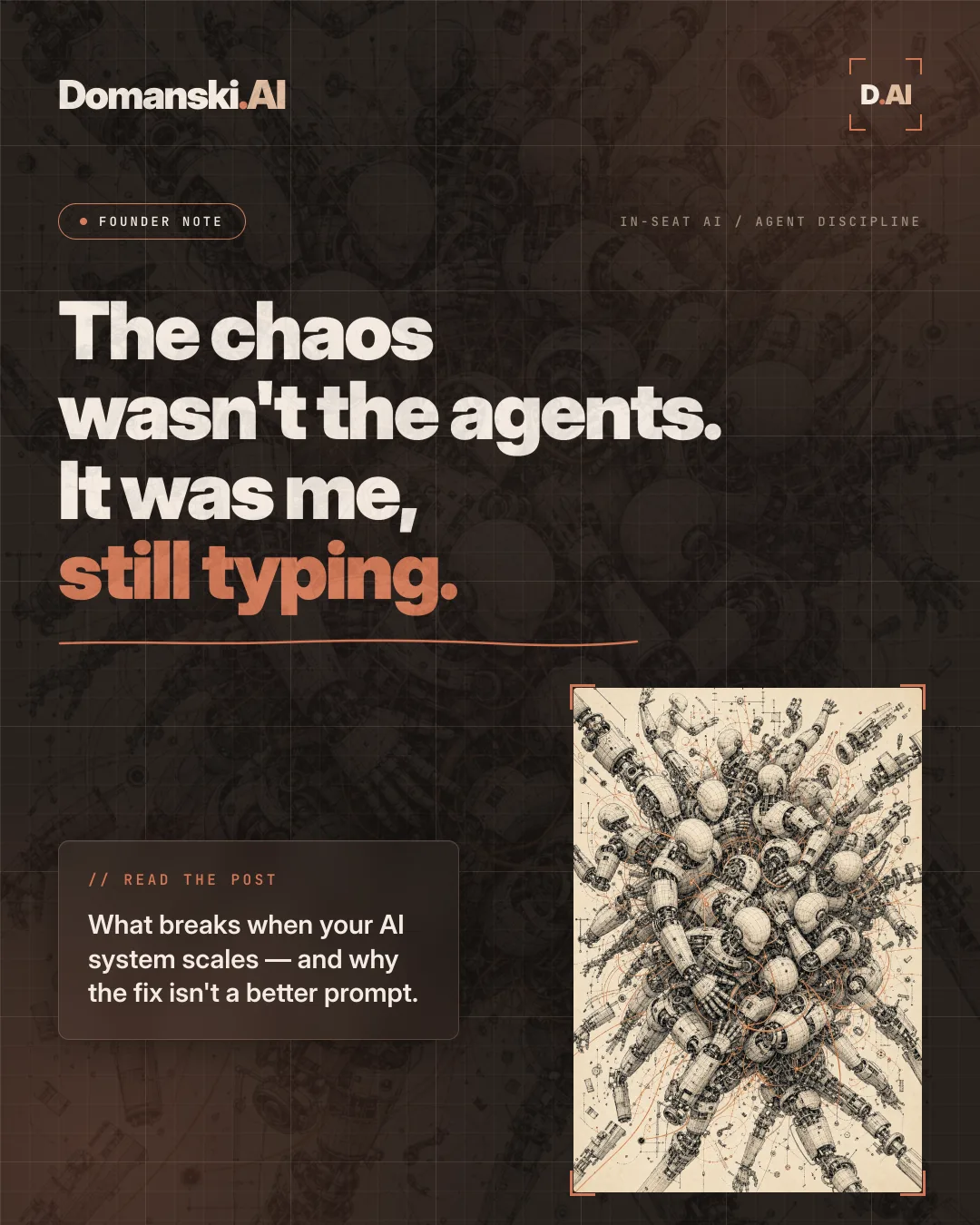
The easiest mistake with agents is to keep adding them.
One agent helps. Three agents feel powerful. Ten agents feel like a company. Then the boundaries blur, context bleeds, and nobody can tell which instruction caused which output. The stack gets louder while the work gets less trustworthy.
The problem is not the number of agents. The problem is discipline.
Every agent needs a boundary
An agent without a boundary becomes a helpful generalist. Helpful generalists are where scope goes to die.
The role has to be narrow enough to refuse work. This agent writes the report and nothing else. This agent checks the evidence and nothing else. This agent prepares the brief and nothing else. The refusal matters because it keeps context clean.
// The rule
If the agent cannot say, "that is not my lane," the operator has not installed a role. They have opened a chat window.
Memory has to live somewhere durable
Chat memory is not operations memory. The operator needs files, reports, and a written source of truth the next run can read cold.
That is why In-Seat AI treats Memory as a layer. Not because memory is fashionable. Because the operator cannot re-explain the business every morning and still call the system production.
Reports are part of the product
An agent that does work but leaves no receipt creates a new management problem. The operator has to inspect the output, infer what happened, and guess whether the same mistake will repeat.
A useful agent reports what it did, what it refused, what changed, what evidence passed, and what needs a human decision. The report is not admin. It is the handoff between the agent and the operator's judgement.
The operator still decides
The point of agent discipline is not to make the human disappear. It is to remove the repetitive work around the human's judgement so the judgement can get sharper.
That is the difference between agent sprawl and an installed system. Sprawl gives you more output. Discipline gives you output the operator can own.